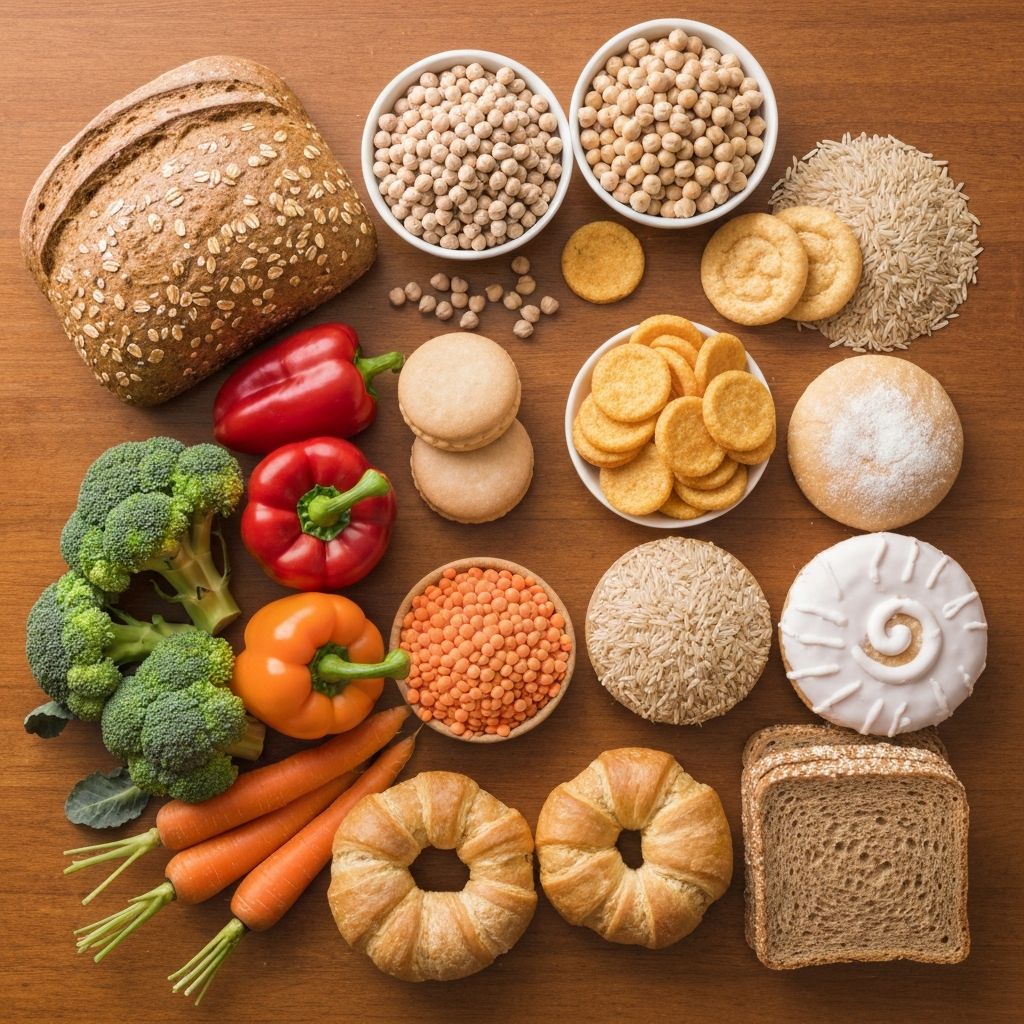
Role of Fibre-Rich Alternatives in Traditional Meals
Fibre represents a significant component of food composition with documented physiological roles. Understanding fibre-rich food alternatives and their composition provides scientific context for the macronutrient structure of British meals without dietary prescription.
Fibre Classification and Function
Fibre exists in two primary forms, each with distinct composition characteristics:
- Soluble fibre: Fermentable by gut bacteria, found in oats, barley, beans, lentils, some vegetables. Approximately 1–8g per 100g of source food.
- Insoluble fibre: Non-fermentable, found in whole wheat, bran, nuts, seeds, legumes. Approximately 2–12g per 100g of source food.
- Total dietary fibre: Combined total of both types. UK recommended intake: 30g daily for adults based on clinical epidemiology.
- Typical UK intake: Approximately 18–20g daily, suggesting fibre density in everyday food choices affects total population intake.
Grain Alternatives: White vs Whole Grain Comparison
The fundamental compositional difference between refined and whole grain products:
| Item | Per 100g (kcal) | Protein (g) | Fat (g) | Fibre (g) | Carbs (g) |
|---|---|---|---|---|---|
| White Bread | 265 | 9 | 1.5 | 1.5 | 49 |
| Wholemeal Bread | 249 | 10 | 2 | 5.8 | 42 |
| White Rice (cooked) | 130 | 2.7 | 0.3 | 0.4 | 28 |
| Brown Rice (cooked) | 111 | 2.6 | 0.9 | 1.8 | 23 |
| White Pasta (cooked) | 131 | 5 | 1.1 | 1.8 | 25 |
| Whole Wheat Pasta (cooked) | 124 | 5.3 | 0.4 | 4.7 | 21 |
| Oats (dry) | 389 | 17 | 7 | 10.6 | 66 |
| Oatmeal (cooked) | 68 | 2.4 | 1.4 | 1.7 | 12 |
Legume Composition: Fibre and Protein Sources
Legumes provide substantial fibre and protein contributions to meal composition:
Lentils (cooked)
Per 100g: 116 kcal
Protein: 9g
Fibre: 8.8g (primarily soluble)
Carbs: 20g
Chickpeas (cooked)
Per 100g: 134 kcal
Protein: 8.9g
Fibre: 7.6g
Carbs: 22.5g
Baked Beans in Sauce
Per 100g: 81 kcal
Protein: 5g
Fibre: 5g
Carbs: 14g
Split Peas (cooked)
Per 100g: 118 kcal
Protein: 8g
Fibre: 8.1g (primarily soluble)
Carbs: 21g
Vegetable Composition: Fibre Density Analysis
Vegetables common in British meals provide varying fibre densities:
- Broccoli (cooked): 34 kcal/100g, fibre 2.4g, protein 2.8g
- Carrots (cooked): 35 kcal/100g, fibre 2.4g, beta-carotene high
- Spinach (cooked): 23 kcal/100g, fibre 2.2g, iron/folate source
- Cabbage (cooked): 22 kcal/100g, fibre 2.2g, vitamin C source
- Peas (cooked): 81 kcal/100g, fibre 5.5g, protein 5.4g
- Sweet Potato (cooked): 63 kcal/100g, fibre 2.7g, beta-carotene high
- Potato with skin (cooked): 77 kcal/100g, fibre 1.1g when boiled
Nuts and Seeds: High Fibre, High Fat Sources
Nuts and seeds provide substantial fibre within higher energy density:
| Item | Per 100g (kcal) | Fibre (g) | Protein (g) | Fat (g) |
|---|---|---|---|---|
| Almonds | 579 | 3.5 | 21 | 50 |
| Walnuts | 654 | 3.7 | 9 | 65 |
| Linseeds (ground) | 534 | 27 | 18 | 42 |
| Chia Seeds | 486 | 34 | 17 | 31 |
| Sunflower Seeds | 584 | 8.6 | 21 | 51 |
Traditional Meal Modification: Composition Impact
Substitution of traditional meal components with fibre-rich alternatives affects overall nutritional composition:
- Swap white bread for whole grain: Reduces energy approximately 16 kcal per serving, increases fibre by 4.3g per typical two-slice portion
- Swap white rice for brown rice: Reduces energy approximately 19 kcal per 100g cooked, increases fibre by 1.4g per portion
- Swap regular pasta for whole wheat: Reduces energy approximately 7 kcal per 100g cooked, increases fibre by 2.9g per portion
- Add legumes to meal: 150g lentils adds 174 kcal, 13.5g protein, 13.2g fibre to meal composition
- Include peas in meal: 100g peas adds 81 kcal, 5.4g protein, 5.5g fibre
Composition Across Traditional Meal Patterns
Daily fibre intake from traditional British meals varies substantially based on ingredient selection:
- Day consuming white bread, white rice, refined pasta: Approximately 12–15g fibre typical
- Day consuming whole grain alternatives consistently: Approximately 25–30g fibre possible with same portion sizes
- Day including 2–3 legume servings: Fibre content increases 15–20g from legumes alone
- Day including vegetable-rich meals: 5+ portions vegetables = approximately 12–15g fibre